Gemma 4 Is Here — Google's Newest Open-Weight Models
April 2, 2026. Multimodal. Apache 2.0. Ready for your device.
Google DeepMind released Gemma 4 recently — April 2, 2026.
I’ve been scrolling through tech news and forums waiting for something new to come up. Finally, it dropped. I’ve been tracking the open-weight LLM space closely, and this is also one of the open-weight models that I’ve been waiting for and can’t wait to talk about. Four new models dropped on April 2, all Apache 2.0:
- E2B (effective ~2B) — tiny, efficient, runs on almost anything
- E4B (effective ~4.5B) — the sweet spot for laptops and phones
- 26B MoE (4B active) — high quality, fast inference
- 31B dense — the big one, maximum capability
And yes, they’re all multimodal now. Images, video, audio — built in from the start, not bolted on later.
What’s New?
Multimodal Without the Hassle
Gemma 4 just works with images and audio out of the box. No “oh right I need to load a separate vision model first.” The models natively understand:
- Images (variable aspect ratios, flexible token budgets)
- Audio (speech recognition on E2B/E4B)
- Video (end-to-end reasoning)
This is useful if you’re deploying on-device and don’t want to juggle multiple models. One model does everything.
Math & Reasoning Got Better
The 31B dense model hit 89.2% on AIME 2026. That’s competitive with the best closed-weight models at this size. Instruction following is also noticeably sharper — less “I think you mean…” and more just doing it.
Agentic Capabilities
Gemma 4 was built from the ground up for autonomous agents. Key features:
- Native function calling — structures API calls correctly, no guessing games
- Structured JSON output — clean, parseable responses (no regex hell)
- Multi-step planning — breaks complex tasks into executable steps
- t2-bench score: 86.4% — competitive with much larger models
Google built this to power Android Studio’s Agent Mode, but it works anywhere you need tools and APIs. It’s genuinely good at multi-step workflows, not just chat.
So, How Does It Stack Up? (Gemma 4 vs Qwen3.5)
Alright, let’s talk numbers because I know you’re curious. I have a feeling Qwen3.5 27B will still be my go-to for coding — so I dug up some benchmark results to see if my hunch holds water. Spoiler: it does, but with a twist.
The Benchmarks (TL;DR)
Gemma 4 31B Dense vs Qwen3.5-27B Dense
| Benchmark | Gemma 4 31B | Qwen3.5-27B | Winner |
|---|---|---|---|
| MMLU-Pro (knowledge) | 85.2% | 86.1% | Qwen ✅ |
| GPQA Diamond (science) | 84.3% | 85.5% | Qwen ✅ |
| LiveCodeBench v6 (coding) | 80.0% | 80.7% | Qwen ✅ |
| Tau2 (agent tasks) | 76.9% | 79.0% | Qwen ✅ |
| MMMLU (multilingual) | 88.4% | 85.9% | Gemma ✅ |
| MMMU-Pro (vision+reasoning) | 76.9% | 75.0% | Gemma ✅ |
Gemma 4 26B MoE vs Qwen3.5-35B-A3B MoE
| Benchmark | Gemma 4 26B-A4B | Qwen3.5-35B-A3B | Winner |
|---|---|---|---|
| MMLU-Pro (knowledge) | 82.6% | 85.3% | Qwen ✅ |
| GPQA Diamond (science) | 82.3% | 84.2% | Qwen ✅ |
| LiveCodeBench v6 (coding) | 77.1% | 74.6% | Gemma ✅ |
| Tau2 (agent tasks) | 68.2% | 81.2% | Qwen ✅ |
| MMMLU (multilingual) | 86.3% | 85.2% | Gemma ✅ |
| MMMU-Pro (vision+reasoning) | 73.8% | 75.1% | Qwen ✅ |
The Arena AI Leaderboard (Real Talk from Users)
I also checked Arena AI’s open-source leaderboard — this is where people actually chat with these models and give them ratings:
| Model | ELO Score | Rank Among Open Models |
|---|---|---|
| Gemma 4 31B | 1452 ± 9 | #3 overall 🥉 |
| Qwen3.5-397B-A17B | 1449 ± 6 | #4 overall |
| Gemma 4 26B-A4B | 1441 ± 9 | #6 overall |
| Qwen3.5-122B-A10B | 1416 ± 6 | ~#8 |
| Qwen3.5-27B | 1404 ± 6 | ~#10 |
| Qwen3.5-35B-A3B | 1400 ± 6 | ~#11 |
What This Means for Practitioners 🤔
Static tests: Qwen3.5-27B beats Gemma 4 31B in 4 out of 6 categories (coding, knowledge, science reasoning). The margins are small — like 0.7% to 1.2% — but consistent. If you’re building tools that require precise reasoning or heavy coding, Qwen’s got the edge.
But here’s where it gets interesting: On Arena AI, Gemma 4 ranks higher than comparable Qwen models. The 31B variant is #3 overall at ELO 1452, while Qwen3.5-27B sits around #10 with 1404. That’s a 48-point gap!
What does this mean? Users seem to prefer Gemma for:
- Casual conversation and back-and-forth chat
- Natural-sounding responses
- Feeling more “assistant-like” in practice
Meanwhile, Qwen feels… clunkier in dialogue mode, even though it’s technically stronger on paper.
My Verdict
For coding-heavy workloads: Still sticking with my gut — Qwen3.5-27B is the pick. LiveCodeBench lead + stronger agent behavior (Tau2) = better for actually writing code or building tools.
For multimodal/multilingual edge use cases: Gemma 4’s native image/audio support and MMMLU strength might be worth the tradeoff. Especially if you’re deploying on-device where conversation flow matters more than raw benchmark scores.
Bottom line: Benchmarks confirm my preference — Qwen3.5 is sharper on technical tasks. But if conversational smoothness is your priority, Gemma could feel better in real use. You should probably test both locally to see which one just feels right for your use case.
Edge AI: What I Actually Tried on My Phone
Edge AI is about running models directly on your device — no internet required. This matters for anyone who needs AI to work offline, whether you’re traveling through areas with poor connectivity or simply value privacy and speed.
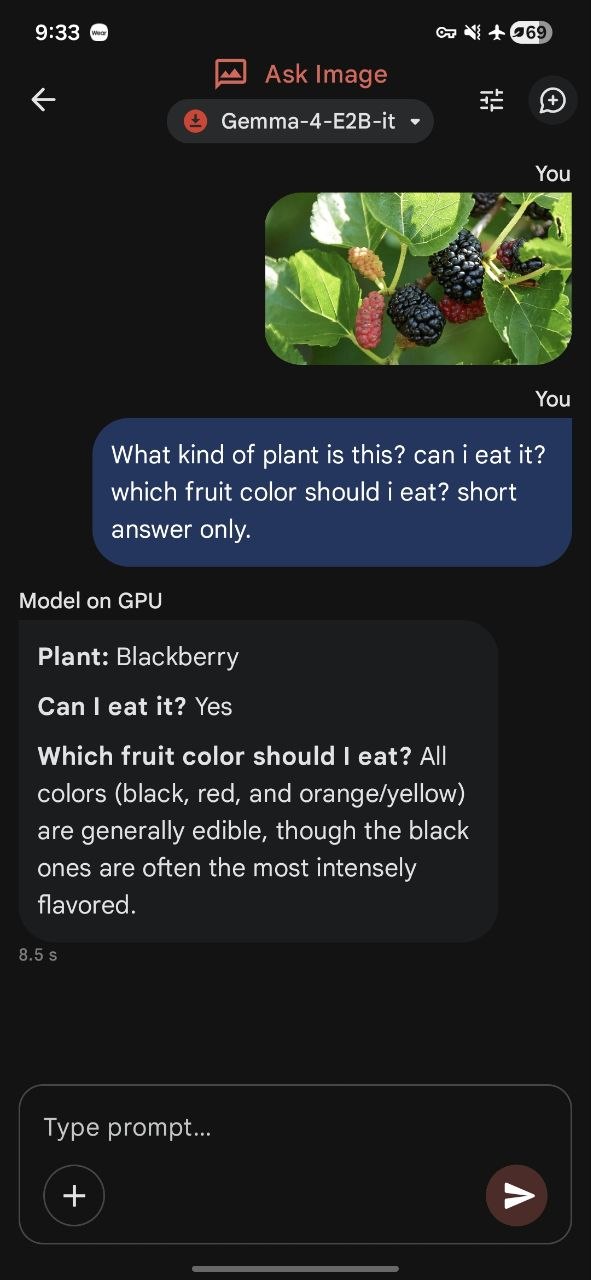
I put Google’s AI Edge Gallery app to the test. It demonstrates how Gemma 4 can run locally on a phone, processing images and text without ever sending data to the cloud. The setup is straightforward: install the app, load the model, and you have an offline-capable assistant running entirely on your hardware.
What Actually Works Offline
- Document Q&A (upload a PDF, ask questions)
- Image analysis (take a photo of a map, menu, error message)
- Audio transcription and translation
- Basic text generation for drafting or brainstorming
The tradeoff? Edge models prioritize speed and efficiency over raw intelligence. They’re designed for quick, practical tasks — not to compete with the massive cloud models on complex reasoning. For emergency scenarios where you just need to understand something or draft a quick note without internet, they’re surprisingly capable.
Final Thoughts
Gemma 4 is impressive — especially for what it tries to do. Google’s clearly aiming at the “AI assistant on your phone” use case, and the multimodal capabilities are a real differentiator. But if you’re building something that demands precision (coding, technical reasoning), Qwen3.5 still edges it out.
The real winner here might be having both options available — pick whichever fits your workflow better.